

A position built between speed and contact
Rugby positions are often described too neatly. Forwards do the heavy work; backs do the running. A centre immediately exposes the weakness in that shortcut.
Tommaso Menoncello is listed by GEARXPro as a Benetton Rugby and Italy centre. Publicly, his breakthrough is well documented: he became the youngest winner of the Guinness Men's Six Nations Player of the Championship award in 2024. None of that tells us his private equipment routine, and it would be wrong to invent one. What his position does give us is a useful way to think about the demands placed on the equipment below the ankle.
A centre can accelerate into space, stop when a defensive picture changes, plant for a sharp angle, carry through contact and then repeat. The boot has to remain predictable across very different actions.
What elite rugby data actually shows
Research on elite rugby union separates the game by position for good reason. One study found that backs covered more total distance and more high-speed running than forwards, while forwards accumulated more contact actions. Other work on repeated high-intensity passages shows that backs still experience sequences combining sprints, tackles and rapid changes in activity.
That does not mean every centre needs a particular sock or boot. Positional data describes group tendencies, not individual prescriptions.
The more useful conclusion is that a rugby setup has to cope with transitions. A player does not change footwear between a straight-line chase, a deceleration and a collision. The same foot-to-boot system has to work through all three.
There are three different kinds of “grip”
Players often use one word for several separate problems.
Boot-to-ground traction comes mainly from the outsole, stud geometry and playing surface. Wet natural grass, firm ground and artificial turf are different traction environments.
Foot-to-boot stability is about what happens inside the shoe. Size, shape, lacing, sock thickness and friction all affect how much the foot can move relative to the upper and insole.
Kit stability is the practical question: does everything remain where it should after repeated running, contact and getting up from the floor?
Grip socks act mainly at the second interface. They do not make studs grip the pitch more strongly and they do not rescue an incorrectly sized boot.
Why Menoncello is a useful case study
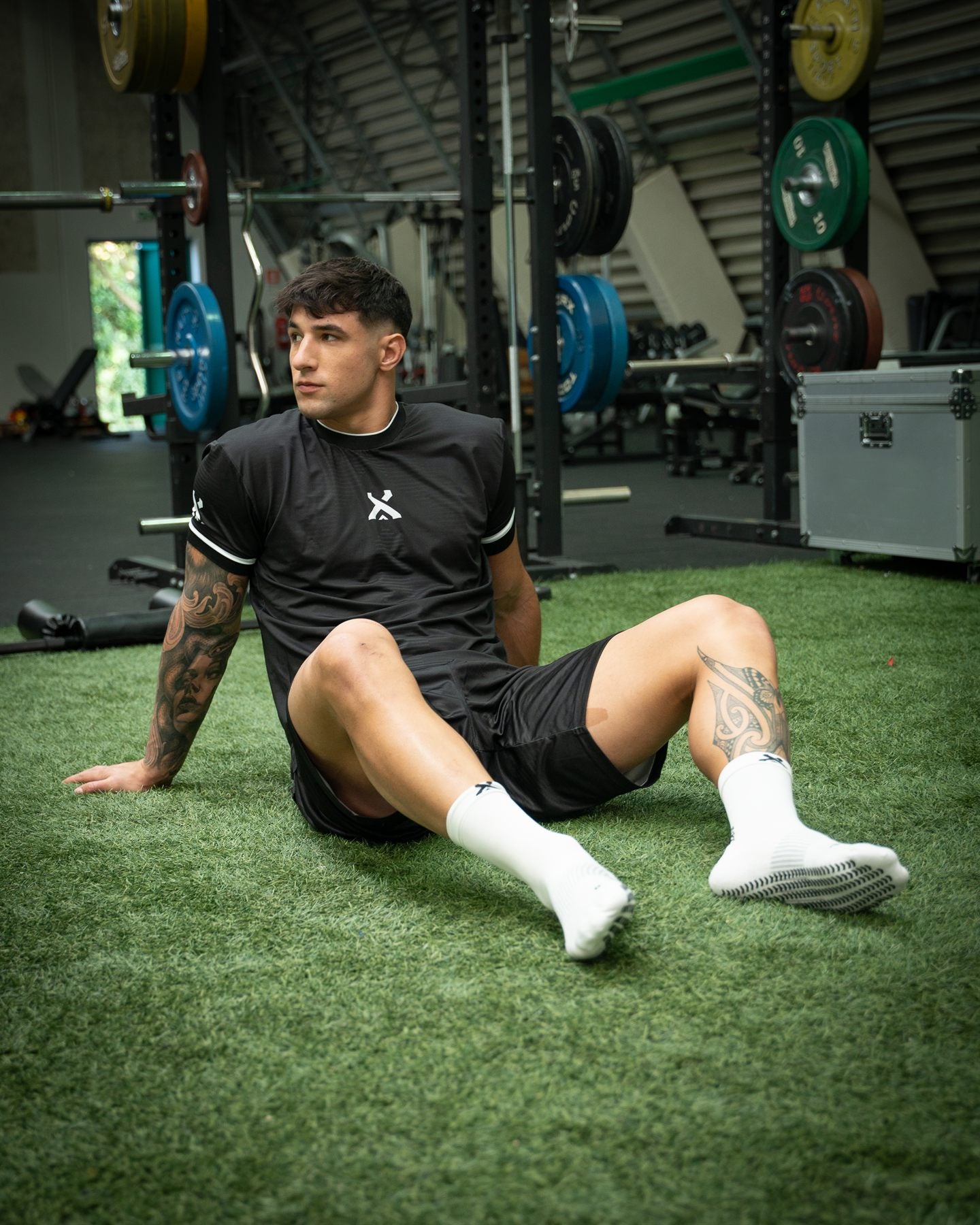
GEARXPro's ambassador profile connects Menoncello with SOXPRO Classic. That should be read as product context, not proof that the sock creates elite performance.
Classic uses Grip:IN zones under the foot and at the heel to limit unwanted movement inside the boot. For a role that repeatedly accelerates, brakes and changes direction, the logic is straightforward: a more consistent internal fit can be useful when movement changes quickly.
It is not the only valid choice. A very close-fitting speed boot may make an athlete prefer less sock volume. Another player may value more structure. On a saturated pitch, outsole choice is likely to matter before sock choice.
Five questions for your own rugby setup
Copying a professional's kit is less useful than observing your own foot.
At top speed: does the heel stay seated or lift?
When braking: does the forefoot slide towards the toe box?
When cutting: does the foot rotate inside the boot before the boot changes direction?
After contact: has the lacing loosened or has the sock bunched?
After training: are the same hot spots appearing in the same places?
These questions separate fit problems from traction problems. If the boot is too narrow, adding friction is not the answer. If it is too long, heel movement may be a sizing issue. If the problem is slipping on the field, the outsole deserves attention first.
Why more grip is not automatically better
Rugby equipment works as a system. The aim is not to maximise friction everywhere.
The foot still needs enough room for natural movement. The boot must suit the surface. The sock must fit without creating folds or unwanted bulk. Lacing should secure the midfoot without turning the shoe into a clamp.
A stable setup is one that feels predictable, not one that feels rigid.
The limits of the comparison
Menoncello's role is a lens, not a template. Body mass, foot shape, surface, weather, boot construction and personal preference all change the answer.
The research has similar limits. Group averages can tell us that backs generally face more high-speed running, but they cannot tell us exactly what one centre will experience in one match.
That is why the strongest equipment decisions begin with the athlete's own problem.
The most interesting part is the part television misses
The visible moments in rugby are obvious: a line break, a dominant carry, a hard defensive read. What is less obvious is the number of small interfaces that have to stay reliable for those movements to repeat.
The connection between foot, sock and boot is one of them.
Looking at a centre such as Menoncello is therefore more useful when it changes the question from “what does an elite player wear?” to “does my setup stay consistent when I move from speed to contact and back again?”